Last week I was on a trip to some places on the German Baltic Sea coast in Mecklenburg-Vorpommern. The first stop was Wismar followed by Rostock, Warnemünde, Stralsund and the island Rügen. Everywhere I went I bought some cards for my collection.
Wismar was an early member of the Hanseatic League and after the Thirty Years' War it became a part of Sweden. Large parts of the town and especially of the old town were damaged in World War II, but after they were rebuilt Wismar turned into an important tourist destination and is today the sixth largest city in Mecklenburg-Vorpommern.
Like many cities on the Baltic Sea coast Wismar is home to important buildings in the style of the Brick Gothic. Especially the three big churches, Saint Nicholas, Saint Mary and Saint George, are worth the mention.
The Saint Nicolas' Church was built between 1381 and 1487 as church of the seafarers and fishermen. Of Wismar's three big churches only this one survived World War II without big damages.
Another famous sight of Wismar are the gabled houses.
Rostock is the largest city in Mecklenburg-Vorpommern. Last year it celebrated its 800th birthday and this year the 600th founding anniversary of the university is celebrated. The city was a founding member of the Hanseatic League in 1259. After destructions in World War II Rostock became the largest port, the most important shipbuilding place and a district capital in the German Democratic Republic.
The Town Hall of Rostock dates back to the 13th century and is thus the oldest secular building in Rostock. It is considered to be one of the most important buildings in the style of the Brick Gothic, although big parts of the Medieval building are covered by Baroque additions. While I was in Rostock, the city prepared for a run-off for the mayoralty on the 16th June. The winner was the Danish citizen Claus Ruhe Madsen, who became the first foreign mayor of a German big city.
The Saint Mary's Church is the Lutheran main church of Rostock. It was built between 1290 and the middle of the 15th century and is one of the most important buildings in the style of the Brick Gothic. Its rich features include an astronomical clock.
The Saint Peter's Church is the oldest and tallest of the three big churches in the city. It was the place where the Reformation was introduced to Rostock.
The Kröpelin Gate was built around 1270 and is one of the largest gates of Rostock's former city wall. As it was located on the street to Lübeck and Wismar, the gate was designed as symbol of Rostock's Hanseatic importance.
The Zoological Collection Rostock is a scientific university collection and associated with the zoological department of the University of Rostock. The collection was founded in 1775. It is used both for teaching and research.
The Cultural History Museum of Rostock was founded in 1859 and is thus one of the oldest museums in Northern Germany.
Warnemünde was first mentioned in 1195. In 1323 it was bought by the prosperous Rostock and due to this belonging Warnemünde did not have it its own rights. For 300 years, between 1567 and 1867, own trade, seafaring and handicraft were forbidden. In the 19th century Warnemünde turned into a seaside resort and ferry port. Today is Warnemünde one of the World's busiest cruise ports.
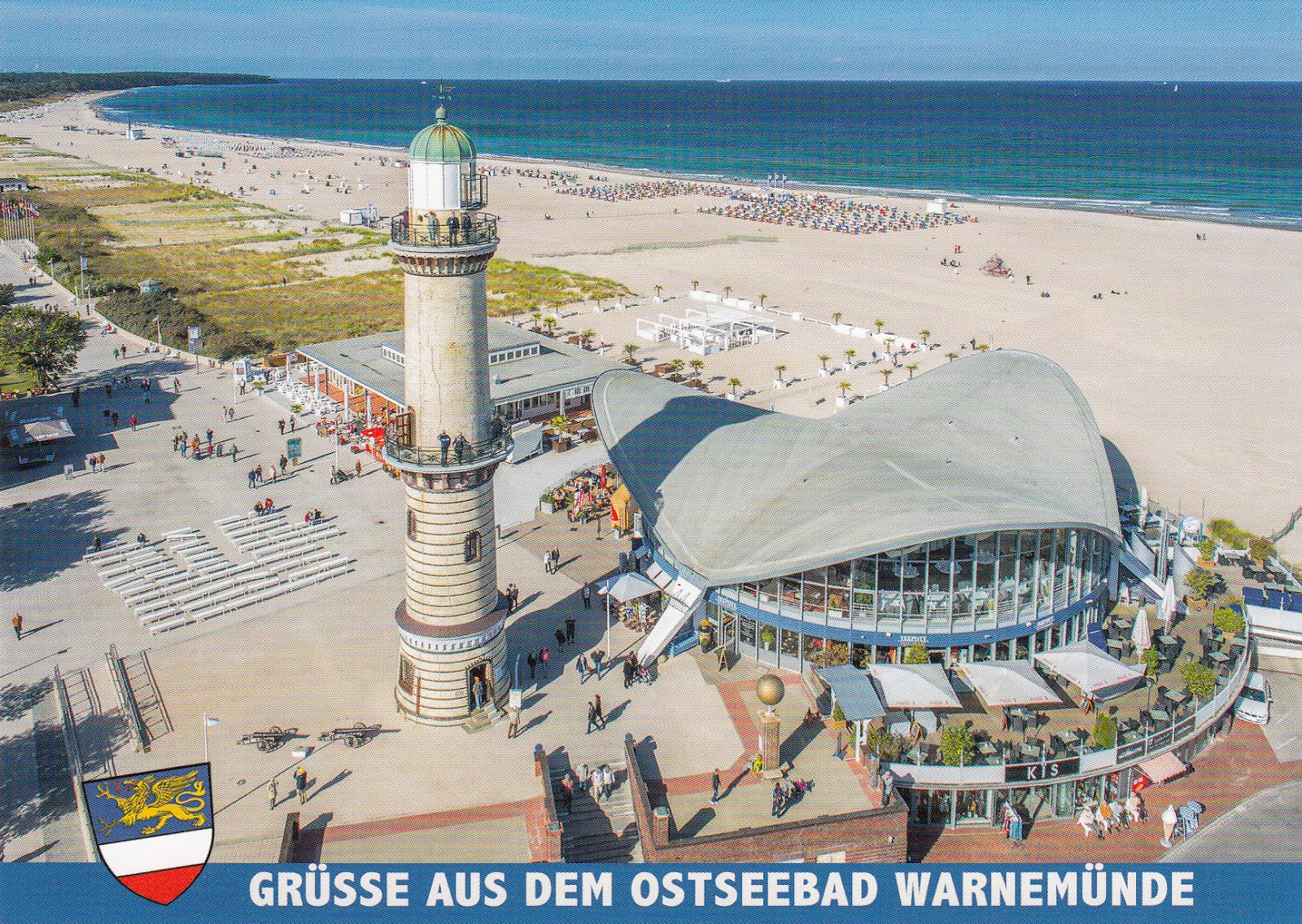
I have sent this card to myself during my trip.
The Warnemünde Lighthouse was put into service in 1898. In 1968 the Teepott was erected next to it after an older pavillon burned down in 1945. With its curved roof it is one of the most famous examples of East German architecture.
Stralsund was founded in 1234 as city with Lübeck Law. Due to its favourable location it grew quickly. It joined the Hanseatic League in 1293 and soon became one of its most important cities. In 1370 the Treaty of Stralsund was signed by Denmark and the Hanseatic League, which is considered to be league's peak of power. In the 15th and 16th century Stralsund's importance decreased and the Thirty Years' War meant another setback. Between 1648 and 1815 the city belonged the Sweden and then became a part of Prussia.
I have sent this card to myself during my trip. The stamp I used commemorates the 750th anniversary of Stralsund's Saint Catherine's Monastery (issued 13-06-2001).
One of my favourite cards bought during my trip shows an aerial view of Stralsund. Since 2002 is the Historic Centre of Stralsund together with the one of Wismar on the UNESCO World Heritage List.
The German Oceanographic Museum is a museum about the oceans and everything connected with them. It was founded in 1951 and is housed in the former Saint Catherine's Monastery. Next to its exhibits it is also home to nearly 50 aquaria.
The Ozeaneum is a museum and aquarium, which belongs to the German Oceanographic Museum. It was opened in 2008 and quickly turned into a popular tourist destination. Thanks to it the German Oceanographic Museum is today the most visited museum in Northern Germany. In 2010 the Ozeaneum got the European Museum of the Year Award.
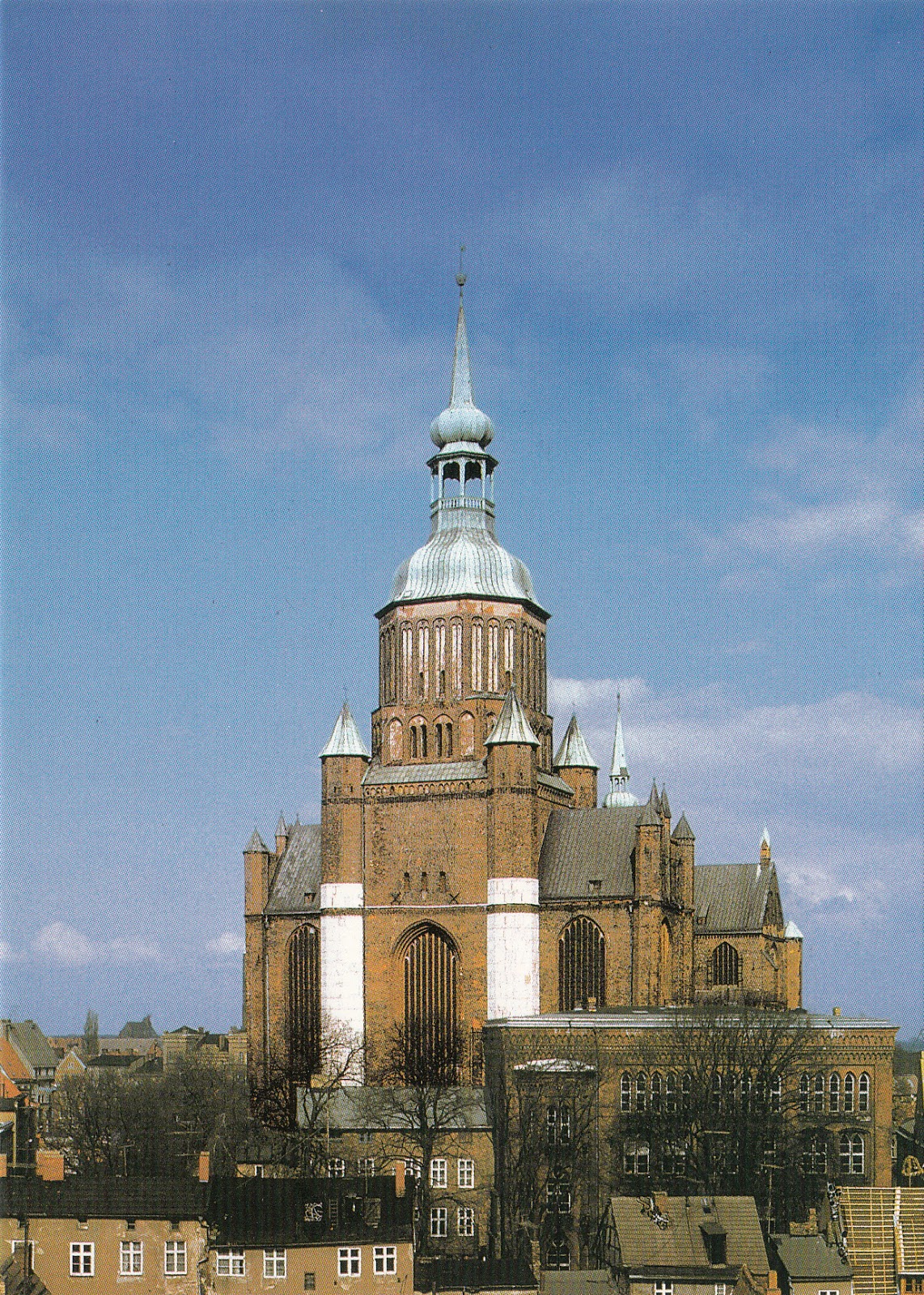
The Saint Mary's Church is the largest church in Stralsund. It is considered to be a Late Gothic masterpiece in Central Europa. Between 1549 and 1569 and again from 1573 to 1647 it was the tallest building in the World.
The Saint Jacob's Church is the youngest of Stralsund's three big churches. Currently it is used as cultural venue and not for services.
The Saint Nicholas' Church is the oldest of Stralsund's three big churches. It was not only a place of worship but was also used as council church.
The Town Hall of Stralsund is located next to the Saint Nicholas' Church. The construction began in the late 13th century and it was frequently added to until the 20th century. It is considered to be one of the most important secular buildings in the Baltic Sea area. In 1370 it was the place were the Treaty of Stralsund was signed.
The Stralsund Museum was founded in 1859 and is thus the oldest museum in Mecklenburg-Vorpommern. Just like the German Oceanographic Museum it is housed in the former Saint Catherine's Monastery. Its current name it just got in 2015. Earlier it was known as Cultural History Museum.
Rügen is the largest, most populous and second-most visited German island.
The Rügen Bridge connects Rügen with Stralsund. It was opened in 2007. Already earlier Rügen was connected with the mainland by the Rügen Causeway, which is still in use today.
Binz is the largest seaside resort on Rügen. It is known for its historical resort architecture.
The Granitz Hunting Lodge is located near Binz. It was built between 1837 and 1846. Once it was a popular holiday destination for European nobility and prominent people and today it is the most visited castle in Mecklenburg-Vorpommern.
The Colossus of Prora is a colossal Nazi-planned holiday resort on Rügen and a particularly striking example of Third Reich architecture. It was built between 1936 and 1939 as a Strength Through Joy project and was designed to provide affordable holidays for the average worker, but was never used for this purpose. Later the buildings were used by the East German National Peoples Army. In recent years it was sold and redeveloped.
The Rügen narrow-gauge railway is a steam-powered narrow-gauge railway that connects various seaside resorts. It is nicknamed Rasender Roland, Raging Roland.
The Jasmund National Park was founded in 1990. It is home to the largest coherent beech forest of the German Baltic Sea Coast and the largest chalk cliffs in Germany. It is the smallest national park in Germany. The beech forests of the Jasmund National Park were added to the UNESCO World Heritage List together with four other Ancient Beech Forests of Germany in 2011.
During my trip I was also able to get a few cards of places I have not visited myself.
The Doberan Minster is the remaining part of the former Cistercian Doberan Abbey, the first monastery in Mecklenburg which was once the region's religious centre. It is a masterpiece of the Brick Gothic architecture and of all former Cistercian churches in Europa it has the largest amount of the original interior remaining intact.
The Heinrich Schliemann Museum in Ankershagen is a museum about the life of Heinrich Schliemann, the discoverer of Troy. Originally opened in 1986, it was recently closed for renovation and just reopened in early June 2019.
The Molli railway is a narrow-gauge steam-powered railway connecting Bad Doberan, Heiligendamm and Kühlungsborn.