Showing posts with label Poland. Show all posts

Saturday, August 13, 2022

Poland: Jewish Historical Institute

On 12th April I got two postcards from Poland.

One of them shows the Jewish Historical Institute in Warsaw. The Jewish Historical Institute is a public cultural and research institution dealing with the history of Jews in Poland and Jewish culture. It was founded in 1947 and is housed in the building of the former Main Judaic Library

Stamps about the Year of the Ox (issued 26-02-2021) and the Year of the Tiger (issued 01-02-2022) were used on this card. Four smaller values about Rail Crossing Safety Awareness (issued 30-05-2020) and the 40th anniversary of the Solidarity Union of Farmers (issued 12-05-2021) had to be used as well to reach the right amount of postage. 


Thank You very much Marcel!

Poland: Oskar Schindler's Enamel Factory

On 12th April I got two postcards from Poland.

One of them comes from Oskar Schindler's Enamel Factory. Oskar Schindler's Enamel Factory is a former metal item factory. It is one of the places where Oskar Schindler saved the lives of Jews during the Holocaust by employing them and now houses a museum. Shown on the card is a wall of Kraków Ghetto shown at the museum. 

Two stamps were used here. The left stamp celebrates the Centenary of the Civil Service in Poland (issued 17-02-2022) and the right stamp honours Poland's Support for Ukraine (issued 25-03-2022). During the still ongoing war waged by Russia against its neighbour Poland became one of Ukraine's most important supporters. 


Thank You very much Marcel!

Poland: Oświęcim Castle

On 9th April I got a postcard from Poland.

It shows Oświęcim Castle. Oświęcim Castle dates back to the Middle Ages and was once the residence of the Duchy of Oświęcim, one of the many Duchies of Silesia. Nowadays it is home to a museum. The city of Oświęcim however is internationally better known under its old German name Auschwitz due to being the site of the infamous Nazi concentration camp.

Used on the card were two stamps about the Winter Olympic and Paralympic Games in Beijing (issued 24-01-2022). They got a nice and clear postmark from Oświęcim.


Thank You very much Marcel!

Friday, August 12, 2022

Poland: Gliwice Radio Tower

On 7th April I got two postcards: one from Poland and one from Austria.

The card from Poland shows the Gliwice Radio Tower. The Gliwice Radio Tower is a transmission tower and the tallest wooden structure in Europa. It was erected in 1934/35 as Sendeturm Gleiwitz when the territory belonged to Germany. On 31st August 1939 the SS staged a "Polish" attack on the station, which was later used as justification for the invasion of Poland and thus the beginning of World War II. Since 2005 the station houses a branch of the Gliwice Museum about radio history and art.

Two nice stamps were used here. The small one on the left promotes Vaccinations against Covid-19 (issued 15-07-2021) and the right stamp celebrates the 75th anniversary of the United Nations (issued 24-10-2020). 


Thank You very much Marcel!

Tuesday, November 16, 2021

Poland: Gdańsk

On 18th September I got a postcard from Poland.

It shows three famous sights of Gdańsk, the Neptune's Fountain, the Artus Court and the Main Town Hall. Gdańsk is a city on the Baltic coast and the sixth largest city in Poland. This is a city full of history. Once a leading member of the Hanseatic League, it was later a part of Prussia and a semi-autonomous city state in the Interwar Period. In the 1980s it was also the birth place of the Solidarity movement. I hope to visit this city one day. 

The stamps on this official card look suspiciously like they had been used before.


Thank You very much Bartosz!

Sunday, September 26, 2021

Poland: Łódź

On 10th June I got a postcard from Poland.

It shows various views of Łódź. Łódź is the third largest city in Poland and a centre of education, entertainment and industry. The main view of this card shows the Izrael Poznański Palace, the former residence of Izrael Poznański, one of the key industrialists that drove the textile revolution in Łódź. The palace was marked for its opulence and grand size and distinguished itself from the surrounding residences. Since 1975 it is home to the Museum of the City of Łódź. 

The stamp shows Jerzy Iwanow-Szajnowicz, a Greek-Polish athlete who fought as a saboteur in the Greek Resistance during World War II and was executed by the Nazis. It was issued on 25th March 2021.


Thank You very much Lukas!

Tuesday, April 20, 2021

Poland: Floriańska Street in Kraków

Last Thursday I got a postcard from Poland.

It shows the Floriańska Street in Kraków. Floriańska Street is a street in Kraków's Old Town running from the Saint Florian's Gate to the Market Square. The view on this card faces towards the Market Square and Saint Mary's Church can be seen in the background. Many shops as well as monuments are located on this street. The most famous of them might be the former house of famous painter Jan Matejko. This card is such a nice reminder of My Trip to Kraków back in 2019, when I passed this street multiple times.

Three interesting stamps were used on the card. On the right is Poland's Year of the Ox stamp (issued 26-02-2021). After the Year of the Rat this is already the second Polish stamp about Chinese New Year. Like last year's issue it is round. The stamp in the middle is from a set of three about Dinosaurs (issued 25-11-2020). Shown on this one is the predatory dinosaur Dilophosaurus. The other two stamps show Scelidosaurus and Coelophysis. This set was apparently rather popular among collectors, as it is already sold out in the Polish Post's online shop and as a second set was already announced for 2022. The last stamp commemorates the 5th anniversary of the Territorial Defence Force (issued 14-02-2021), the fifth military branch of the Polish Armed Forces made up of professional and part-time volunteer soldiers. The two stamps on the right were cancelled with a special Postcrossing postmark from Wrocław. Throughout the year two different Postcrossing postmarks are used in the city. This one shows bees, while the other one shows storks.


Thank You very much Ola!

Wednesday, December 23, 2020

Poland: Christmas

Last Wednesday I got two postcards: one from Poland and one from the United Kingdom. 

The card was Poland is a Christmas card sent through official Postcrossing.

One of the three Christmas stamps issued on 16th November 2017 was used on this card. A very similar one was issued this year and I was actually a bit shocked to notice that Poland did not issue any Christmas stamps in 2018 and 2019. The upper pair shows the collegiate Church of Głogów (issued 25-09-2020).


 Thank You very much Joasia!

Friday, December 18, 2020

Poland: Regional Museum in Wągrowiec

On 28th October I got a postcard from Poland.

It shows the Regional Museum in Wągrowiec. The Regional Museum is housed in the former residence of the local Cistercian abbey's abbot. It was founded in 1986 and shows exhibits about the town's history and the region's ethnography as well as art and photographs. 

Two interesting history-themed stamps were used. The left stamp commemorates the 80th anniversary of the Katyn Massacre (issued 04-04-2020), a series of mass executions of over 20000 Polish military officers and educated people carried out by the Soviet NKVD in April and May 1940. The discovery of the mass graves by Nazi Germany three years later led to the severation of diplomatic relations between the Polish government-in-exile in London and the Soviet Union, as the former asked for an investigation by the Red Cross. Just 50 years later the executions were officially acknowledged and condemned. The rather small stamp on the right commemorates the 40th anniversary of Solidarność (issued 31-08-2020), the trade union which played a vital role in the end of the communist rule in Poland.


 Thank You very much Paulina!

Wednesday, June 3, 2020

Poland: Old View of Kraków

Last Monday I got a postcard from Poland.

It shows an old view of Kraków with the Wawel Hill and the Vistula River. It is a nice reminder of my trip there last year and it is interesting to see how it changed. This view is from 1896.


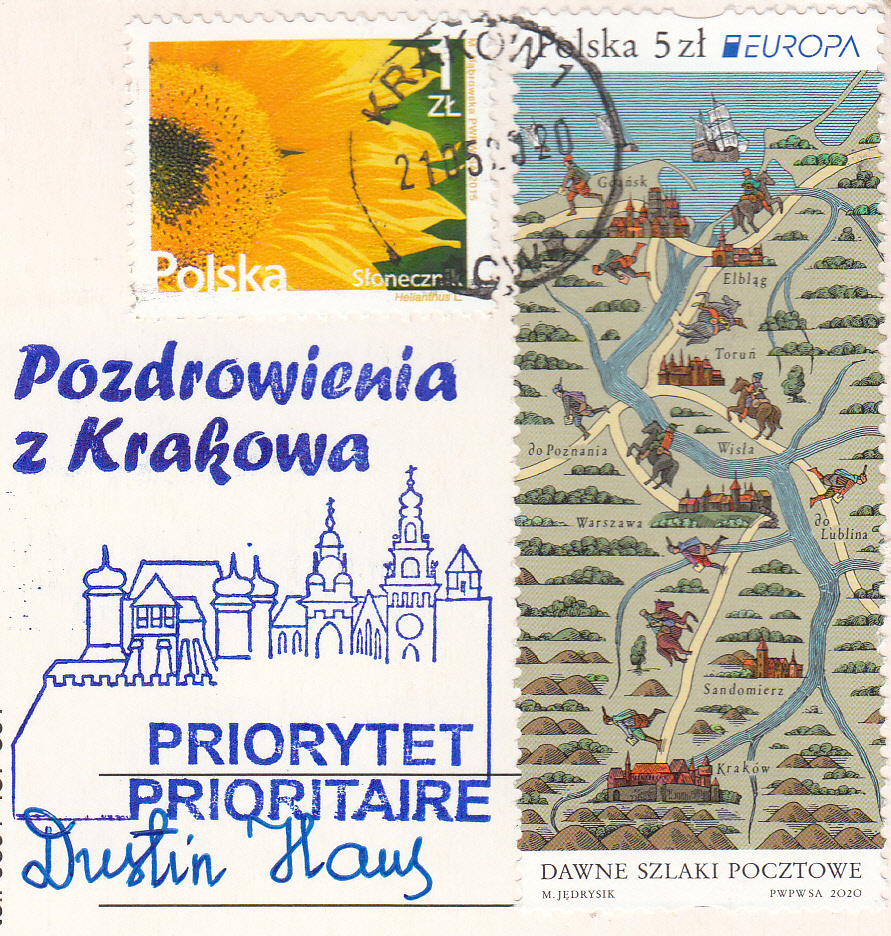
Even more important than the card is the nice stamp. It is Poland's EUROPA stamp for this year (issued 29-04-2020) and deals with the Vistula River as old postal route. I really like the little illustrations of some of the most important Polish cities like Kraków, Warsaw and Gdansk. To reach the current postage for a card to Germany a second stamp was added. This one shows a sunflower (issued 26-06-2015).


Thank You very much Wojtek!

Friday, February 28, 2020

Poland: Polish Post Office in Gdańsk

On Saturday I got a postcard from Poland.

It shows the Polish Post Office in Gdańsk. After World War I Gdańsk or Danzig in German was a semi-autonomous city state separated from both the newly independent Poland and the German Weimar Republic. It was under protection of the League of Nations and was put into a customs union with Poland. Also certain rights about communication, the port and the railway were given to Poland. While the free city also had its own postal service, a special Polish post office was created as well. Its building was considered Polish extraterritorial property and even had its own stamps, mainly Polish stamps overprinted with "Port Gdańsk". As tensions between Germany and Poland grew, the post office was prepared for hostilities and fortified. When World War II began on the 1st September 1939, the Polish Post Office was one of the first sites of fighting, but it was not as easily captured as the aggressors thought. In fact the Polish personnel defended the building for some 15 hours against units of the SS, the SA and the local police. After the defenders eventually had to surrender, all of them were sentenced to death by a German court martial as illegal combatants a month later and executed. Only four were able to escape during the surrender. In Poland the episode has become one of the better known episodes of the Polish September Campaign and it is usually portrayed as a heroic story of David and Goliath proportions, in Germany it is mainly known from The Tin Drum by Günter Grass. In 1979 a museum was established in the building and also it is still used as post office.


With a related stamp:
Sunflower (issued 26-06-2015)
Cornflower (issued 20-01-2016)
80 years Defense of the Polish Post Office in Gdańsk (issued 01-09-2019)


Thank You very much Doris!

Friday, February 14, 2020

Poland: Szczecin

Last Tuesday I got two postcards: one from Poland and one from Japan.

The card from Poland shows cranes in Szczecin. Szczecin is the capital and largest city of the West Pomeranian Voivodeship. It is located near the Baltic Sea and the German border and is a major seaport. Also it is Poland's seventh-largest city. Between 1630 and 1720 the city was a part of Sweden and as such it was since 1648 even the capital of Swedish Pomerania. In 1720 it was acquired by Prussia and then the German Empire. Following World War II Szczecin became part of Poland in accordance with the Potsdam Agreement. 


Stamps:
75 years Liberation of Auschwitz (issued 27-01-2020)
Year of the Rat (issued 27-01-2020)


Thank You very much Kasia!

Saturday, November 9, 2019

Poland: Poznań Goats

Last Saturday I got two postcards from Poland.

One of them shows the Poznań Goats. The Poznań Goats, the display of mechanical fighting goats played out daily at noon above the clock on the front wall of the Town Hall of Poznań, is one of the city's symbols and main tourist attractions.


Stamp:
Centenary of Diplomatic Relations with the Holy See (issued 29-03-2019)
with a special postmark showing also the Poznań Goats


Thank You very much Joanna!

Poland: Poznań

Last Saturday I got two postcards from Poland.

One of them shows the Market Square of Poznań. Poznań is the fifth largest city of Poland and the capital of the Greater Poland Voivodeship. It is an important centre of trade, education, culture, technology and tourism.


Stamps:
Father Michał Tomaszek and Father Zbigniew Strzałkowski (issued 05-12-2015)
300 years Bamber Community of Poznań (issued 19-10-2019)
with First Day Special Postmark


Thank You very much Joanna!

Sunday, October 27, 2019

Poland: Wrocław Meet-up with Postcrossing Postmark

Last Friday I got three postcards: one from Poland, one from Belgium and one from Finland.

The card from Poland is one of the official postcards of the Postcrossing Meet-up in Wrocław.


Stamp:
Łącko Apple (issued 18-07-2014)
with a special Postcrossing postmark celebrating also the 150th birthday of the Postcard


Thank You very much Joanna!

Wednesday, October 23, 2019

Poland: Malbork Castle

On Thursday I got four postcards: one from Poland, one from Spain, one from India and one from Finland.

The card from Poland shows Malbork Castle. Malbork Castle was built in the 13th century by the Teutonic Knights. Between 1309 and 1454 it was the seat of the Grand Master of the Teutonic Knights and afterwards it was a Polish royal residence. After falling into decay, it was meticulously restored in the 19th and early 20th century with many conservation techniques which are now accepted as standard. It is a fine example of a medieval brick castle and one of the largest brick buildings in Europa. The Castle of the Teutonic Order in Malbork is since 1997 on the UNESCO World Heritage List.


Stamp:
Rose (from set of two) (issued 15-09-2015)


Thank You very much Ania!

Sunday, October 13, 2019

Poland: Auschwitz Concentration Camp

On 4th October I got a postcard from Poland.

It shows the main gate of the Auschwitz Concentration Camp. The Auschwitz Concentration Camp was a complex of over 40 concentration, extermination and labour camps built and operated by Nazi Germany in occupied Poland during World War II. It operated between 1940 and the liberation in January 1945 and became an international symbol of humanity's cruelty to its fellow human beings and especially of the Holocaust. During the war 1.3 million people were sent to Auschwitz, of which at least 1.1 million died. Many of those prisoners not killed in the gas chambers died because of starvation, forced labor, infectious diseases, individual executions and medical experiments. Approximately one in six Jews killed in the Holocaust died at the camp, but the prisoners were not only Jews, but also non-Jewish Poles, Roma, Soviet prisoners of war, Jehovah's Witnesses, members of diverse nationalities and gay men. Already in 1947 the Auschwitz-Birkenau Memorial and Museum was established, which is today among the most visited museums in the World. Since 1979 is Auschwitz-Birkenau on the UNESCO World Heritage List.


With a matching stamp:
Never again! (issued 27-01-2018)
Independence Anniversaries of Israel and Poland (issued 05-11-2018)
It is a joint issue with Israel. 


I sent this card to myself during my recent visit to Kraków. As I did not visited Auschwitz myself, I just got the cards I found in the city. Apart from the card above, which I got at the Galicia Jewish Museum, I only found one other card.


Monday, October 7, 2019

My Trip to Kraków

Between the 22nd and 26th September I was in Kraków where I bought many cards for my collection.

Kraków is the second largest and one of the oldest cities in Poland. Until 1569 it was the capital of the Kingdom of Poland. Today it is an important academic, cultural and economic centre. The Historic Centre of Kraków was one of the first sites to be added to the UNESCO World Heritage List in 1978. In 2000 was Kraków the European Capital of Culture.


The Main Square or Rynek Główny is the principal urban space in Kraków. It dates back to the 13th century and is one of the largest medieval town squares in Europe. Many important events in Kraków's and Poland's history happened on this place. Two examples are the Prussian Homage of 1525 and mass demonstrations of the Solidarity movement. Today the square is one of the most important tourist destinations in Kraków and is known for its lively street life.


The Saint Mary's Cathedral is a Catholic church on Kraków's Main Square. It was built in the 14th century in the Brick Gothic style and is considered to be one of the best examples of Polish Gothic architecture. A special treasure of the church is the Altarpiece of Veit Stoss.


The Kraków Cloth Hall or Sukiennice is the central feature of the Main Square. It was once a major centre of international trade, where traveling merchants met to discuss business and to barter. Its current appearance dates back to the Renaissance. During its golden age in the 15th century the hall was the source of a variety of exotic imports from the east like spices, silk, leather and wax, while textiles, lead, and salt were exported from there.


The Adam Mickiewicz Monument in front of the Cloth Hall is one of the best known bronze monuments in Poland. It was unveiled in 1898 to commemorate the 100th anniversary of the birth of Adam Mickiewicz, the greatest Polish Romantic poet of the 19th century. In 1940 the monument was destroyed by the Nazis amid tears of the local population and was restored in 1955.


Located under the Main Square is the Rynek Underground, a museum about medieval trade in Kraków and the city's European identity. It was opened in 2010.


The Wawel Hill is a fortified architectural complex erected over many centuries atop a limestone outcrop on the left bank of the Vistula River at an altitude of 228 metres above sea level. It is a place of great significance to the Polish people.


The Wawel Cathedral is a Roman Catholic church located on Wawel Hill. It is a Polish national sanctuary, as it was the place were the Polish Kings were coronated and were many are also buried beside other famous persons of Polish history such as Józef Piłsudski or Adam Mickiewicz. Sigismund's Chapel, built at the behest of Sigismund I the Old between 1517 and 1533 and adjoining the southern wall of the cathedral, is one of the most notable pieces of architecture in Kraków and perhaps the purest example of Renaissance architecture outside Italy. The church is also the Cathedral of the Archdiocese of Kraków and as such strongly connected to Karol Wojtyla, who in 1978 became Pope John Paul II.


The Wawel Castle is one of the largest castles and one of the most historically and culturally significant sites in Poland. It represents nearly all European architectural styles of medieval, renaissance and baroque periods. Until 1609 it was the residence of the Polish Kings, but after that tough times for the castle began. After the Third Partition of Poland in 1795 for example the castle was mostly demolished and the remaining part was modernised by Austrians with defensive walls and used as barracks, which just ended when Franz Joseph I of Austria made it a royal residence again.


In Polish folklore the Wawel is famous as home of the Wawel Dragon, which was immortalised by a metal sculpture placed at the foot of the hill in 1972.


Kazimierz is a district of Kraków, which was an independent city until the 19th century. Since it was founded in the 14th century it had been a place of coexistence and interpenetration of Polish and Jewish cultures, which lasted until the Jewish inhabitants were forcibly relocated by the Nazis in 1941. Today Kazimierz is one of the major tourist attractions of Kraków and an important center of cultural life of the city.


Located in Kazimierz is the very interesting Galicia Jewish Museum. The Galicia Jewish Museum shows a photo exhibition documenting the remnants of Jewish culture and life in Polish Galicia, which used to be very vibrant in this area. The exhibition was created by the British photojournalist Chris Schwarz and Professor Jonathan Webber as a result of a twelve-year collaboration. It was opened in 2004.


At the museum I also found a card of the Tempel Synagogue, a major place of worship and booming center of Jewish culture, which I visited before I visited the museum.


The National Museum in Kraków was established in 1879 and is today the main branch of Poland's National Museum. While the Main Building features one of the largest galleries of painting and sculpture from the late 19th century on in Poland, other divisions of the museum are spread around the city.


The most famous exhibit that is currently shown at the Main Building is Leonardo da Vinci's Lady with an Ermine. The painting was bought in Italy in 1798 by Prince Adam Jerzy Czartoryski and due to various wars and political conflicts it was moved various times between Kraków, Puławy, Sieniawa, Paris, Dresden, Berlin, Wrocław and Schliersee in Bavaria. Apart from various exhibition journeys around the World it had been shown in the Czartoryski Museum in Kraków since 1946. As that museum is currently renovated, the painting is shown in the National Museum instead.


One of the divisions of the National Museum is the Sukiennice Museum in the Cloth Hall, which was actually the main location when the museum was founded in 1879. Today it holds the largest permanent exhibit of the 19th century Polish painting and sculpture shown in four grand rooms. The collection includes some of the most famous and important Polish paintings of that period like Prussian Homage by Jan Matejko (unfortunately no postcard available), Nero's Torches by Henryk Siemiradzki or Ecstasy by Władysław Podkowiński.


The Europeum is the youngest branch of the National Museum and was just opened in 2013. It shows the collection of European art of the National Museum. A masterpiece shown at the museum is The Sermon of Saint John the Baptist by Pieter Brueghel the Younger. Also it currently shows Rembrandt's Landscape with the Good Samaritan, which actually belongs to the Czartoryski Museum.


The Jagiellonian University was founded by Casimir III the Great in 1364 and is thus the oldest university in Poland, the second oldest university in Central Europe and one of the oldest surviving universities in the World. Notable students include Nicolaus Copernicus, Stanisław Lem and Karol Wojtyła. It is traditionally considered Poland's most reputable institution of higher learning. The Collegium Maius is the university's oldest building and houses the Jagiellonian University Museum.


The Kraków Barbican is a fortified outpost once connected to the city walls and a historic gateway leading into the Old Town of Kraków. It is one of the few remaining relics of the complex network of fortifications and defensive barriers that once encircled the city.


Oskar Schindler's Enamel Factory is a former metal item factory. It is one of the places where Oskar Schindler saved the lives of Jews during the Holocaust by employing them and now houses a museum.


The Eagle Pharmacy was during World War II the only pharmacy within the borders of Kraków's ghetto. It was a source of various resources and medicaments which helped in avoiding deportation and was used as a place for conspiratorial meetings.


In Pomorska Street was the headquarters of the Gestapo in Kraków. Together with Oskar Schindler's Enamel Factory and the Eagle Pharmacy it forms a memorial trail.


The Church of Saints Peter and Paul is a Roman Catholic Baroque church. It is especially known for the sculptures of apostles in front of it.


The Grunwald Monument is an equestrian statue of King of Poland Władysław II Jagiełło and was constructed in 1910 to commemorate the 500th anniversary of the Battle of Grunwald. It was destroyed in 1939 by the Nazis, but was reconstructed in 1976.


 The Juliusz Słowacki Theatre is a Eclectic theatre-opera house erected in 1893. It was modeled after some of the best European Baroque and Eclectic theatres.


Nowa Huta is the easternmost district of Kraków. It was created as Socialist ideal city and was supposed to be an ideological counterweight to the liberal Kraków, but failed to do so.


The Nativity scene or szopka tradition in Kraków is since 2018 an Intangible Heritage of the UNESCO.


The two other cards I bought in Kraków are a postal card about Postcrossing, on which I got a special postmark, and an illustration of the Wawel Dragon with a seal of the Town Hall Tower on the backside.