Wednesday, June 15, 2016

Turkey: Library of Celsus in Ephesus

Today I got two postcards: one from Turkey and one from Norway.

The card from Turkey shows the Library of Celsus in Ephesus. Ephesus is a former Greek and later Roman city and was one of the most important cities in Asia minor. It was the location of the Temple of Artemis, one of the Seven Wonders of the Ancient World, and is said to be the place where the Virgin Mary spent the last years of her life. Ephesus is since 2015 on the UNESCO World Heritage List.


Stamps:
Tourism (two from set of five) (issued 20-03-2015)


Thank You very much Tayfun!

Norway: Munch Museum in Oslo

Today I got two postcards: one from Norway and one from Turkey.

The card from Norway shows Edvard Munch's The Scream from the collection of the Munch Museum in Oslo. Edvard Munch was born in 1863. He was a famous Norwegian artist and is considered to be the pioneer of the Expressionism. When he died in 1944, he donated his works and articles to Oslo. The Munch Museum finally opened in 1963. It shows two of the four versions of The Scream, Munch's most famous painting.


With nice stamps:
Posthorn (from set of five) (issued 02-01-1997)
World Skiing Championships (from set of two) (issued 16-02-1982)
Authors - Sigrid Undset (from set of two) (issued 01-10-1982)
Geology (from set of two) (issued 16-09-2005)
Tourism (from set of three) (issued 18-04-1996)


Thank You very much Pei!

Germany: Halle Postcrossing Meet-up

Yesterday I got a postcard from Germany.

It is the official postcard of the 5th Postcrossing Meet-up in Halle.


The card was signed during the meet-up.
Stamp:
Chiemsee (from set of two) (issued 01-07-2015)


Thank You very much Thomas!

cover from Hong Kong

Yesterday I got not only a postcard from Germany but also a cover from Hong Kong.

Stamp:
Definitive (from set of sixteen) (issued 24-07-2014)


Inside was a Japanese postcard.
The card shows Shirakawa-go. Shirakawa-go is a village in the Gifu Prefecture. It is known for its farmhouses built in the Gassho-style. The Historic Villages of Shirakawa-go and Gokayama are since 1995 on the UNESCO World Heritage List.


Thank You very much Phoebe!

Monday, June 13, 2016

Bulgaria: Rock-Hewn Churches of Ivanovo with Postcrossing Stamp

This is the 300th UNESCO World Heritage Site in my collection. Big Thanks to everybody who helped me to achieve this aim!

Today I got two postcards: one from Bulgaria and one from Spain.

The card from Bulgaria shows a fresco from the Holy Virgin's Rock Church, one of the Rock-Hewn Churches of Ivanovo. The Rock-Hewn Churches of Ivanovo are a group of Orthodox church buildings forming a monastery complex. They are carved into stone and differ from all other monasteries in Bulgaria. The frescoes are a special feature of the complex. The Rock-Hewn Churches of Ivanovo are since 1979 on the UNESCO World Heritage List.


Stamps:
Churches (from set of six) (issued 01-09-2000)
Postcrossing (issued 23-12-2015)


Thank You very much Christina!

Spain: Costa Brava and Girona

 Today I got two postcards: one from Spain and one from Bulgaria.

The card from Spain shows three cities on the Costa Brava. The Costa Brava is a coastal region in Catalonia. It is known for its rough coast and its beaches and is a popular tourist destination.
I sent this card to myself during my recent trip.


Stamp:
King Felipe VI (from set of six) (issued 02-01-2016)


Girona is the capital of the Province of Girona in Catalonia and one of the major Catalan cities.


Sant Pere de Rodes is a former monastery. It is a national monument since 1930 and is a part of the Camino de Santiago.


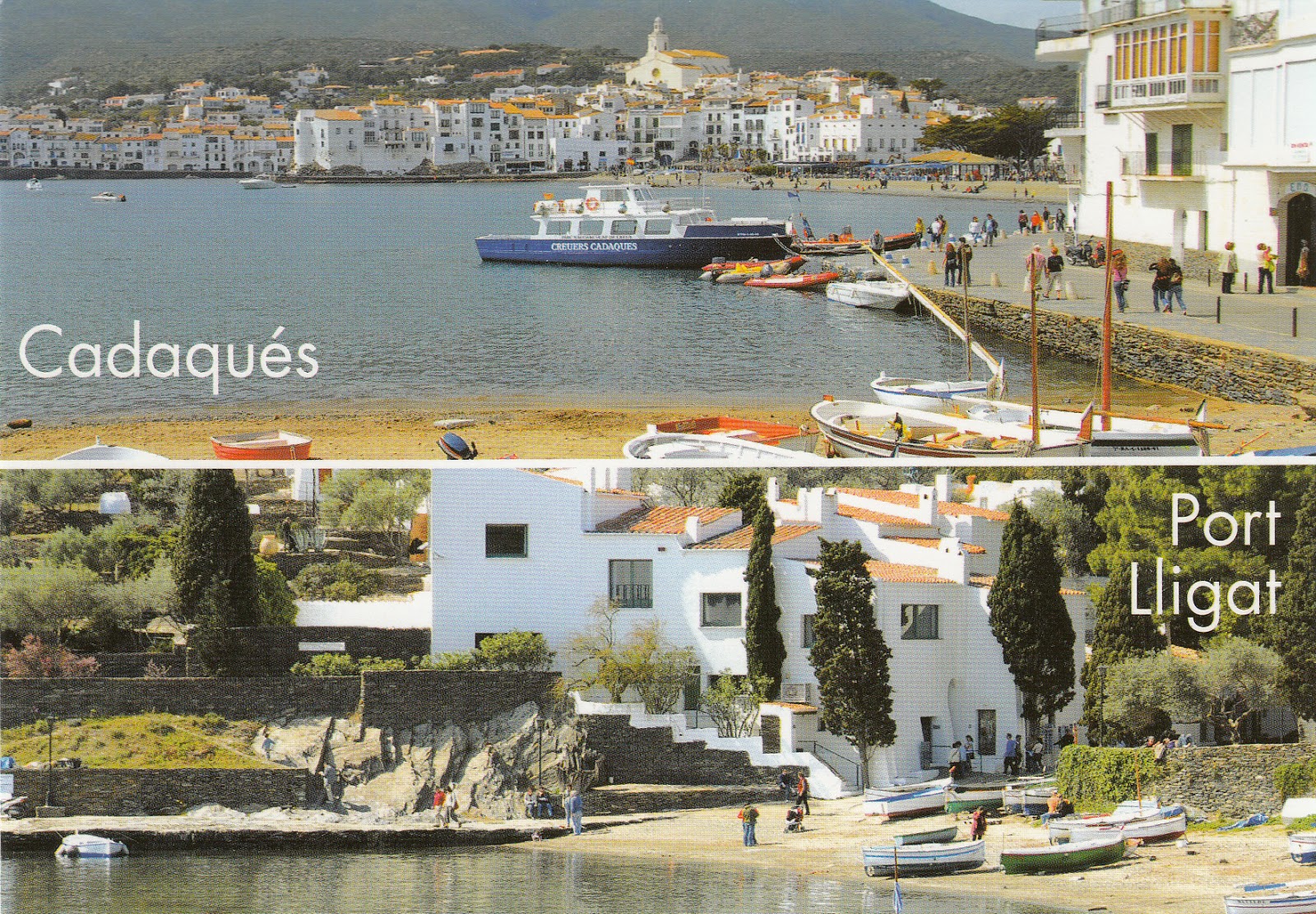
Cadaqués is a small town near the northern point of the Costa Brava. It was once a fishing village, but later became a centre of attraction for famous artists.


The Salvador Dalí House-Museum is located in Portlligat near Cadaqués. It was used as residence by Salvador Dalí between 1930 and 1982.


The Dalí Theatre and Museum in Figueres was opened in 1974 and houses the largest collection of major works by Salvador Dalí in a single location. During Dalí's childhood the building housed the local theatre and it was the place where his paintings were shown for the first time. Dalí is buried in a crypt below the stage floor. It is today the second most visited museum in Spain.


Tossa de Mar is a popular tourist destination on the Costa Brava. It is known for its beaches and historic city centre.


Lloret de Mar is another popular tourist destination on the Costa Brava. The town is mainly known as party location, although there have been attempts in recent years to redefine the town's image.


The Cats' House is a privately owned museum in Lloret de Mar. It was opened in 2002 and shows more than 6000 cat themed exhibits.


The Church of Sant Romà in Lloret de Mar was finished in 1522, but in the beginning of the 20th century it was restored.


The Botanic Garden of Lloret de Mar is considered to be one of the most important botanic gardens on the European Mediterranean coast.


Blanes is a town on the southern point of the Coasta Brava. Its historic centre shows the traditional Catalan life before the tourist invasion.


The Empordà is the fertile hinterland of the Costa Brava. 


covers from Germany

Today I got not only two postcards but also three covers including two from Germany.

Stamp:
Centenary of World War I (issued 07-08-2014)
with a special postmark about the Olympic Games in Berlin in 1916

The 1916 Summer Olympics were planned to be held in Berlin, as the city was selected as host city in 1912. Berlin was actually selected to relieve tensions in Europe, but due to the outbreak of World War I the games had to be cancelled. First the hosts continued their preparations, as no one thought that the war would last until 1916. But later they realised that the war would not be over then, so the 1916 Summer Olympics became the first cancelled Summer Olympics in history. Until now the games had to be cancelled in only two other years, in 1940 and 1944 due to World War II. Instead of hosting the 1916 Summer Olympics Berlin later hosted the 1936 Summer Olympics.


Stamp:
Centenary of World War I (issued 07-08-2014)
with a special postmark showing the SMS Wiesbaden

The SMS Wiesbaden was a light cruiser of the Imperial German Navy. It was commissioned in August 1915, but it already sank on 1st June 1916 during the Battle of Jutland.


cover from the Netherlands

Today I got not only two postcards but also three covers including one from the Netherlands.

Stamps:
EUROPA (whole set) (issued 25-04-2016)


Thank You very much William!

cover from Guernsey

On Saturday I got a cover from Guernsey.

Stamp:
EUROPA (issued 06-05-2016)


Thank You very much William!

Saturday, June 11, 2016

Singapore: Little India

On Tuesday I got two postcards: one from Singapore and one from Indonesia.

The card from Singapore shows various views of Little India. Little India is a district of Singapore with a majority of Tamil residents. In 2013 the district was the location of the first riot in Singapore for more than forty years.


Stamp:
Traditional Board Games (from set of five) (issued 27-04-2016)


Thank You very much Van!

Indonesia: Museum Mandala Bhakti

On Tuesday I got two postcards: one from Indonesia and one from Singapore.

The card from Indonesia shows the Museum Mandala Bhakti. The Museum Mandala Bhakti is located in Semarang. In its exhibitions it shows various military artifacts. It was opened in 1985.


Stamps:
66 years diplomatic relations with Thailand (whole set) (issued 05-05-2016)
It is a joint issue with Thailand.
The stamps were issued with and without hologram. The left stamp is without hologram and the right is with hologram.


Thank You very much Shinta!

Thursday, June 9, 2016

Spain: Catalonia and Barcelona

Last week I was in Catalonia and there I bought some postcards for my collection.

Catalonia is an autonomous community of Spain. It is one of the most economically dynamic Spanish communities. Although Catalonia is one of the communities with the highest degree of autonomy, it seeks for its independence from the rest of Spain. 

The Flag of Catalonia is known as Senyera. It is based on the coat of arms of the Crown of Aragon. If a five-pointed star in a triangle is added to the flag it is known as Estelada and is flown by Catalan independentists.
The Catalan Donkey recently became another symbol of Catalonia. It is used against the Toro de Osborne.


The Paella is a dish from the Spanish east coast. It is based on rice and became a symbol of Valencia.


I found in Catalonia also a very special card showing people in traditional dresses. The dress of the woman is made of real cloth, which was affixed to the card.


Barcelona is the capital and largest city of Catalonia. It is also the second largest city of Spain, the second largest city of the European Union which is not the capital of its country and the largest metropolis on the Mediterranean Sea. Furthermore it is a popular tourist destination and was the fifth most visited European city in 2011. In 1992 the city hosted the Summer Olympics.

The Barcelona Cathedral is a church in the Barri Gòtic, Barcelona's old city centre. It is the seat of the Archbishop of Barcelona.


The Columbus Monument was built between 1882 and 1888. It was built for the Barcelona Universal Exposition held in 1888.


The Palau Nacional was the main building of the 1929 Barcelona International Exposition. It houses since 1934 the National Art Museum of Catalonia.


Antoni Gaudí was a Catalan architect. He was born in Reus in 1852 and died in Barcelona in 1926. He was one of the most important representatives of the Modernisme and his works were inspired by the nature.

Some of his works were added to the UNESCO World Heritage List. In 1984 the Park Güell, the Palau Güell and the Casa Milà were added. In 2005 the site was extended by the Casa Vicens, the crypt and nativity facade of the Sagrada Família, the Casa Batlló and the crypt at the Colònia Güell.
I am looking for a card of the Church of Colònia Güell. Anyone can help?


The Basílica i Temple Expiatori de la Sagrada Família is the most important work of Antoni Gaudí, although it is not completed. Gaudí was involved in the construction between 1883 and his death. It became a basilica minor in 2010 and is the most visited sight of Spain. According to current schedules it will be completed in 2026. Then it will have 18 towers and will be the tallest church in the World.


The Casa Vicens was built between 1883 and 1885. It is the first house designed by Antoni Gaudí and is considered to be one of the first structures built in the style of the Modernisme. There are plans to open the house to the public as museum in late 2016.


The Palau Güell was designed by Antoni Gaudí for his patron Eusebi Güell, a Catalan industrialist. It was built between 1886 and 1888.


The Park Güell is a garden complex with architectural elements created by Antoni Gaudí. It was built for Eusebi Güell between 1900 and 1914.


The Gaudi House Museum is located within the Park Güell. Between 1906 and 1925 it was the residence of Antoni Gaudí and in 1963 the museum opened.


The Casa Batlló was already built in 1877, but between 1904 and 1906 it was redesigned by Antoni Gaudí. It is considered to be one of his masterpieces and one of the most beautiful buildings of Barcelona. The facade depicts the legend of Saint George.


The Casa Milà is the last civil building constructed by Antoni Gaudí and was built between 1906 and 1912. Special features of the building are the wrought iron balconies, the underground garage and the natural air conditioning. It is also known by its nickname La Pedrera, the quarry.


The Hospital de la Santa Creu i Sant Pau is a former hospital complex. It was built between 1901 and 1930 in the style of the Modernisme and was designed by Lluís Domènech i Montaner. It is known for its artistic decorations, but was also perfectly adapted to the needs of the sick. The hospital service ended in 2009 and since 2014 it is used as cultural centre.


The Palau de la Música Catalana was built between 1905 and 1908 according to plans of Lluís Domènech i Montaner. It was designed as concert hall for the Orfeó Català, but is today also used for other musical performances.

The Palau de la Música Catalana and the Hospital de Sant Pau are since 1997 on the UNESCO World Heritage List.


The building of Human Towers is a tradition in many Catalan towns. The Human Towers are since 2010 an Intangible Heritage of the UNESCO.


The Montserrat is a mountain near Barcelona. It is known as location of the Santa Maria de Montserrat Abbey, a symbol of Catalan nationalism.